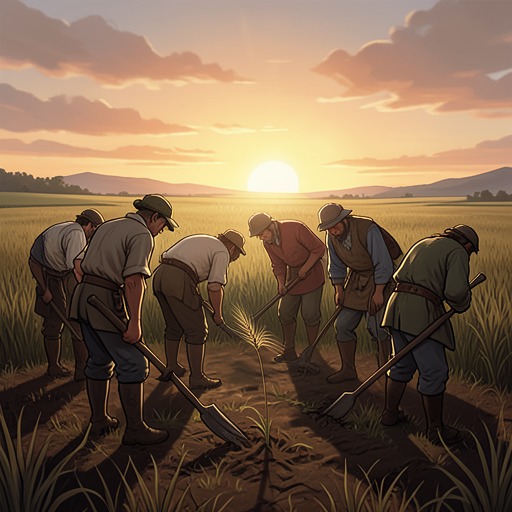
Szymek establishes a homestead at Podlesie
The PeasantsSzymek’s establishment of a homestead at Podlesie turns dispossession into a difficult but self-directed beginning. Driven from his mother’s household without land or a settlement, he does not abandon his claim to a future in Lipce: with Nastusia’s savings and help from neighbors, he buys a neglected plot, marks out a cottage site, and begins clearing the ground himself. The homestead is less a ready-made refuge than a promise made real through labor, assistance, and a willingness to take on land others consider worthless.
The crisis that prompts a new start
Szymek’s immediate predicament is a family and property conflict. He believes that Dominikowa is denying him the land that should come from his father, has driven him out, and will provide no settlement. In despair, he fears having nowhere to go; his anger at his mother’s decision gives way to a practical search for a place of his own. His sister proposes buying six morgen from The Squire at Podlesie and paying in instalments, offering a route forward that does not depend on reconciliation with Dominikowa.
The plan becomes possible because Nastusia has a thousand zlotys to put down. The money is only a beginning, not a complete household: when the group considers the purchase, they still have to reckon with the cottage, livestock, tools, and seed. Szymek nevertheless insists that these needs can be met. He also answers doubts about his ability to farm by recalling the work he already did on his mother’s land: he ploughed, sowed, and brought in the harvest himself. His appeal to his brothers and the other people around him is both an account of past effort and a request for help with a future he cannot yet build alone.
Choosing the unwanted land
Szymek’s proposed purchase is not an easy acquisition of fertile ground. The plot lies beside the forest, with Lipce fields along one side, but is broken by old clay-pit depressions and strewn with rubble and heaps of stone. Briars overgrow it; reeds and rushes crowd its wet hollows, and only scattered pines, alders, and junipers rise from the rough ground. Even The Squire advises against it. Mateusz the Young Villager also regards the tract as a wilderness, but Szymek has already made up his mind to try to make it productive.
The Squire sells the land cheaply, at sixty roubles a morgen, and promises help with wood and other necessities. That assistance does not make the plot ready for settlement; it gives Szymek materials with which to begin. He accepts the bargain and walks the boundaries, where branches stuck in the ground mark the limits. The site’s poor condition and low price make the purchase a gamble, but its location offers practical advantages: the village is opposite, the forest beside it, and wood will be easier to obtain in winter.
From purchase to a place to live
Before setting to work, Szymek prays at a cross, kissing it and going around it on his knees. He rises fortified, then takes a heavy barrow to the plot. The landscape is still difficult to use: the old pits, stones, boggy hollows, and scrub make the work of clearing and levelling substantial. Rather than wait for the land to become welcoming, he takes its condition as the first task of his own household.
He chooses where the cottage should stand, marks its four corners with stones, takes off his sheepskin, crosses himself, and begins clearing and levelling the ground. The work unfolds amid ordinary village activity: herds are driven to pasture, people set out to work, and carts move along the roads. Szymek remains absorbed in his task, pausing to straighten his back and wipe away sweat before returning to the ground. His labor gives physical form to a plan that had begun as a desperate question of where he could go.
Help from the community
Szymek does not organize the work by asking neighbors to come. People consider that he deserves help, yet wait for him to request it; it does not occur to him to do so. When a cart approaches, he is surprised to find a neighbor arriving to help with ploughing. The newcomer explains that he had wanted to come earlier but was afraid because Dominikowa was watching him, and Jagusia had warned him against it. He and Szymek plough together for the day, and he promises to return the next morning, as he does.
The building of the cottage draws further help. Pan Jacek the violinist works alongside Szymek, sharing food and shelter with him, though Szymek still feels too awkward to treat him as a close friend. Mateusz the Young Villager also joins the work for almost a week and urges others to contribute. Adam from the Kłąb family brings the needed wood from the forest. The cottage rises quickly enough to be seen from Lipce; when it is finished, Mateusz hangs a green wreath around the chimney before leaving for work. The building is therefore Szymek’s undertaking, but not a solitary achievement: its completion records the labor and materials others freely bring.
A household taking shape
As the cottage is finished, Pan Jacek the violinist jokes that the nest is ready and Szymek should find it a hen. Szymek replies that the wedding is to take place the next day after vespers. The new home thus stands at the threshold of a marriage with Nastusia, though the account does not present the house as a gift or a finished inheritance. Szymek has bought the ground, cleared a place for the cottage, and helped build it; the wedding follows this practical work of establishing a household.
After the work is done, Szymek continues to wander around the cottage, touch its walls, and look through its windows. He takes pleasure in the smell of lime and fresh clay and repeats to himself that it is his. The movement from a barren plot that even The Squire discouraged him from buying to a completed dwelling gives the event its decisive change: Szymek has exchanged dependence on a mother who will not grant him land for a home secured through purchase, strenuous labor, and reciprocal help. In the wider circumstances of Lipce, where poor villagers face scarce work and hardship, his new holding does not erase deprivation; it establishes a concrete, hard-won possibility of independent life.